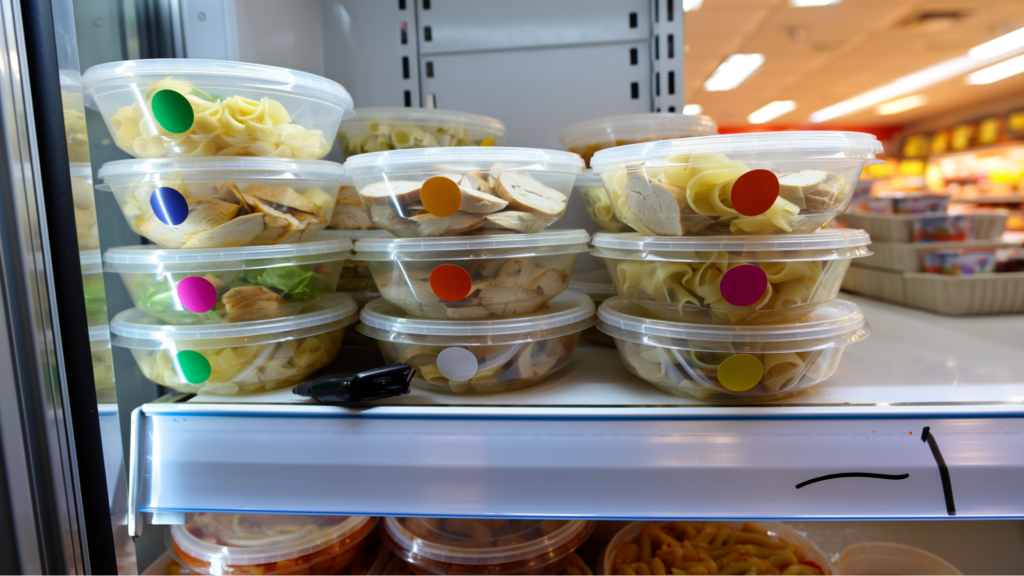
Under the FDA Food Code, refrigerated ready-to-eat food that needs time and temperature control for safety may be held at 41°F or less for a maximum of seven days once it is kept more than 24 hours, and the day it is made or opened counts as Day 1. A tub of chicken salad made on Monday morning reaches Day 7 on Sunday, and a log of deli turkey opened on Monday runs on the same clock. An inspector who follows the model code treats such food, held past 24 hours in a container with no date on it, as food to be discarded, however fresh it smells.
The article quotes the date marking rule as it stands in the 2026 edition of the FDA Food Code on 28 October 2026, from the foods it covers to what happens to the clock when food goes into the freezer. The Cooler Date Card, a one-page tool, turns the rule into a card for the cooler door. None of it is legal advice, and a question about a specific product belongs with your local health department.
Where the rule comes from: a model code your state adopts
Despite the name, the Food Code is not a federal regulation. The preface of the 2026 Food Code says so plainly: “The model Food Code is neither federal law nor federal regulation and is not preemptive.” The FDA’s Food Code 2026 page describes what it is: “The Food Code is a model for safeguarding public health and ensuring food is unadulterated and honestly presented when offered to the consumer.” The FDA describes its use on a separate page, its general FDA Food Code page: “Local, state, tribal, and federal regulators use the FDA Food Code as a model to develop or update their own food safety rules and to be consistent with national food regulatory policy.”
A Food Code provision binds your store only if your state, county or city has adopted it into its own rules, so read every quotation in this article as what your local rule probably looks like if it follows the model.
Every Food Code quotation in this article comes from the FDA Food Code 2026 (PDF). In those quotations, an asterisk and capital letters mark a term the Food Code defines in its Chapter 1. A superscript P or Pf after a provision in the PDF marks its inspection weight, and those letters are left out of the quotations.
Which foods carry a date: ready-to-eat and TCS
The date marking rule reaches one class of food: refrigerated food that is both ready-to-eat and a time/temperature control for safety food, which the code shortens to TCS food. Both terms are defined in Chapter 1 of the Food Code 2026 (PDF).
Ready-to-eat food is defined chiefly as food in a form edible without additional preparation to achieve food safety, and the definition includes, among others, washed raw fruits and vegetables. A sandwich, a tub of potato salad and a cut melon qualify. A raw chicken breast waiting to be cooked does not.
A time/temperature control for safety food “means a *FOOD that requires time/temperature control for safety (*TCS) to limit pathogenic microorganism growth or toxin formation.” The definition then lists what the term includes, naming raw or heat-treated animal food, heat-treated plant food, and plant food that consists of “raw seed sprouts, cut melons, *CUT LEAFY GREENS, cut tomatoes or mixtures of cut tomatoes that are not modified in a way so that they are unable to support pathogenic microorganism growth or toxin formation, or garlic-in-oil mixtures that are not modified in a way so that they are unable to support pathogenic microorganism growth or toxin formation”, with a second item for food its pH and water activity tables flag. Cut melon in a clamshell and sliced tomatoes for the sandwich line are TCS foods, and once refrigerated for more than a day they carry a date.
Food you make in the store: the seven days in 3-501.17(A)
Section 3-501.17 of the Food Code 2026 (PDF), titled Ready-to-Eat, Time/Temperature Control for Safety Food, Date Marking, opens with the rule for food prepared on the premises. Paragraph (A) reads in full: “Except when *PACKAGING *FOOD using a *REDUCED OXYGEN PACKAGING method as specified under § 3-502.12, and except as specified in ¶¶ (E) and (F) of this section, refrigerated, *READY-TO-EAT, *TIME/TEMPERATURE CONTROL FOR SAFETY FOOD prepared and held in a *FOOD ESTABLISHMENT for more than 24 hours shall be clearly marked to indicate the date or day by which the *FOOD shall be consumed on the *PREMISES, sold, or discarded when held at a temperature of 5ºC (41ºF) or less for a maximum of seven days. The day of preparation shall be counted as Day 1.”
Four things in that paragraph decide most cooler questions.
The trigger is time held, and the threshold is 24 hours. Food made for the lunch rush and sold by close never needs a date. Food held more than 24 hours does.
The mark states an end date. The container must show “the date or day by which the *FOOD shall be consumed on the *PREMISES, sold, or discarded”. A system that writes the preparation date instead is permitted by a later paragraph, provided a discard procedure goes with it.
The life is a maximum of seven days, and the count starts on the day the food is made: “The day of preparation shall be counted as Day 1.” Chicken salad made on a Monday reaches Day 7 on Sunday; keeping it through the following Monday adds an eighth day.
The seven days assume the food is “held at a temperature of 5ºC (41ºF) or less”.
The paragraph names its own exceptions in its first line: food packaged with a reduced oxygen packaging method follows section 3-502.12 instead, and paragraphs (E) and (F) carve out customer portions and shellstock.
Food from a package you open: 3-501.17(B)
Paragraph (B) of 3-501.17 in the Food Code 2026 (PDF) states that, “Except as specified in ¶¶ (E) – (G) of this section, refrigerated, *READY-TO-EAT *TIME/TEMPERATURE CONTROL FOR SAFETY FOOD prepared and *PACKAGED by a *FOOD PROCESSING PLANT shall be clearly marked, at the time the original container is opened in a *FOOD ESTABLISHMENT and if the *FOOD is held for more than 24 hours, to indicate the date or day by which the *FOOD shall be consumed on the *PREMISES, sold, or discarded, based on the temperature and time combinations specified in ¶ (A) of this section and:” two further conditions.
The first condition fixes the start of the count: “The day the original container is opened in the *FOOD ESTABLISHMENT shall be counted as Day 1”. The second caps the end of it: “The day or date marked by the *FOOD ESTABLISHMENT may not exceed a manufacturer’s use-by date if the manufacturer determined the use-by date based on *FOOD safety.”
So a log of sliced turkey opened on Wednesday carries a date no later than the following Tuesday, and if the manufacturer’s safety use-by date falls on Saturday, Saturday wins. The clock refers back to paragraph (A), so the same 41°F and seven-day limits apply.
Mixing days: the earliest ingredient sets the date
A store that makes a pasta salad on Friday from chicken cooked on Tuesday does not get a fresh seven days. Paragraph (C) of 3-501.17 in the Food Code 2026 (PDF) covers the combination: “A refrigerated, *READY-TO-EAT *TIME/TEMPERATURE CONTROL FOR SAFETY FOOD ingredient or a portion of a refrigerated, *READY-TO-EAT, *TIME/TEMPERATURE CONTROL FOR SAFETY FOOD that is subsequently combined with additional ingredients or portions of *FOOD shall retain the date marking” of the earliest-prepared or first-prepared ingredient, in the paragraph’s words. Tuesday’s chicken makes Friday’s pasta salad a Day 4 product on the day it is mixed, with Monday as its last day.
Marking methods the code names
The code does not prescribe a label format. Paragraph (D) of 3-501.17 in the Food Code 2026 (PDF) says: “A date marking system that meets the criteria stated in ¶¶ (A) and (B) of this section may include:” four methods, quoted here in the code’s order.
First: “Using a method *APPROVED by the *REGULATORY AUTHORITY for refrigerated, *READY-TO-EAT *TIME/TEMPERATURE CONTROL FOR SAFETY FOOD that is frequently rewrapped, such as lunchmeat or a roast, or for which date marking is impractical, such as soft serve mix or milk in a dispensing machine;”.
Second: “Marking the date or day of preparation, with a procedure to discard the *FOOD on or before the last date or day by which the *FOOD must be consumed on the *PREMISES, sold, or discarded as specified under ¶ (A) of this section;”.
Third: “Marking the date or day the original container is opened in a *FOOD ESTABLISHMENT, with a procedure to discard the *FOOD on or before the last date or day by which the *FOOD must be consumed on the *PREMISES, sold, or discarded as specified under ¶ (B) of this section; or”.
Fourth: “Using calendar dates, days of the week, color-coded marks, or other effective marking methods, provided that the marking system is disclosed to the *REGULATORY AUTHORITY upon request.”
The words may include name methods without closing the list. A store may write the make date or the open date rather than the discard date, but only with a discard procedure that gets the food out on or before its last day. A color-dot or day-of-week system falls under the fourth method, which carries the disclosure condition, and Annex 3 of the code says when the disclosure is made: “provided the system is disclosed to the Regulatory Authority upon request, during inspections.”
What is exempt: customer portions, shellstock and seven processed foods
Three paragraphs of 3-501.17 in the Food Code 2026 (PDF) carve food out of the rule, and each one is narrow.
Paragraph (E): “Paragraphs (A) and (B) of this section do not apply to individual meal portions served or re*PACKAGED for sale from a bulk container upon a *CONSUMER’S request.” A half-pound of coleslaw scooped from the bulk tub for a customer at the counter needs no date. The bulk tub it came from still does.
Paragraph (F): “Paragraphs (A) and (B) of this section do not apply to *SHELLSTOCK”.
Paragraph (G) exempts a closed list from the opened-package rule only. It reads: “Paragraph (B) of this section does not apply to the following *FOODS prepared and *PACKAGED by a *FOOD PROCESSING PLANT inspected by a *REGULATORY AUTHORITY:” and then names seven categories, quoted here in full and in order.
- “Deli salads, such as ham salad, seafood salad, chicken salad, *EGG salad, pasta salad, potato salad, and macaroni salad, manufactured in accordance with 21 CFR 117 Current good manufacturing practice in manufacturing, packing, or holding human *FOOD;”
- “Hard cheeses containing not more than 39% moisture as defined in 21 CFR 133 Cheeses and related cheese products, such as cheddar, gruyere, parmesan and reggiano, and romano;”
- “Semi-soft cheeses containing more than 39% moisture, but not more than 50% moisture, as defined in 21 CFR 133 Cheeses and related cheese products, such as blue, edam, gorgonzola, gouda, and monterey jack;”
- “Cultured dairy products as defined in 21 CFR 131 Milk and cream, such as yogurt, sour cream, and buttermilk;”
- “Preserved *FISH products, such as pickled herring and dried or salted cod, and other acidified *FISH products defined in 21 CFR 114 Acidified *FOODS;”
- “Shelf stable, dry fermented sausages, such as pepperoni and Genoa; and”
- “Shelf stable salt-cured products such as prosciutto and Parma (ham).”
The exemption has two limits. It applies only to paragraph (B), so a deli salad the store makes itself is still dated under paragraph (A), while the same salad bought in a sealed tub is exempt once opened. And it applies only to food from a plant “inspected by a *REGULATORY AUTHORITY”.
Annex 3 of the code draws the line for cured meats on both sides. “Shelf stable fermented sausages such as pepperoni and dry salami do not have to be refrigerated or date marked.” And: “Slices of cured and fermented sausages that require refrigeration and are kept for 24 hours or longer do need to be date marked.”
The annex also settles a question stores ask about retail packs: “It is not the intent of the Food Code to require date marking on the labels of consumer size packages.”
The clock and the freezer: what 3-501.18 says about discarding
Section 3-501.18 of the Food Code 2026 (PDF), Ready-to-Eat, Time/Temperature Control for Safety Food, Disposition, says when dated food leaves the cooler for the bin. Paragraph (A) reads: “A *FOOD specified in ¶ 3-501.17(A) or (B) shall be discarded if it:” and gives three cases.
The first: “Exceeds the temperature and time combination specified in ¶ 3-501.17(A), except time that the product is frozen;”. The second: “Is in a container or *PACKAGE that does not bear a date or day;”. The third: “Is inappropriately marked with a date or day that exceeds a temperature and time combination as specified in ¶ 3-501.17(A).”
The second case is the one that catches stores. A container of food covered by 3-501.17(A) or (B) with no date is discarded, whatever its real age. The third case covers a label that promises more than seven days.
The first case carries the freezer rule in one clause: except time that the product is frozen. Days in the freezer do not count against the seven. Annex 3 explains the reasoning: “Food which is prepared and held, or prepared, frozen, and thawed must be controlled by date marking to ensure its safety based on the total amount of time it was held at refrigeration temperature, and the opportunity for Listeria monocytogenes to multiply, before freezing and after thawing.” So chicken salad made on Monday and frozen on Wednesday, after part of that day in the cooler, has used three days of its seven: Monday, Tuesday and Wednesday. Thawed the following Monday, it has four left, Monday to Thursday, so Thursday is its last day.
The temperature the clock assumes: 41°F
The seven days in 3-501.17(A) are tied to 5ºC (41ºF) or less, and section 3-501.16 of the Food Code 2026 (PDF) sets the same number as the general cold holding rule. Paragraph (A) of 3-501.16 provides that, with stated exceptions for preparation, cooking, cooling and time as a public health control and with paragraphs (B) and (C) covering untreated shell eggs (45°F) and certain liquid food in special equipment, “*TIME/TEMPERATURE CONTROL FOR SAFETY FOOD shall be maintained:” either hot, at 135°F or more with a lower figure for certain roasts, or cold, “At 5°C (41°F) or less.”
The reason the two rules share a number is in Annex 3: “Refrigeration prevents food from becoming a hazard by significantly slowing the growth of most microbes. The growth of some bacteria, such as Listeria monocytogenes, is significantly slowed but not stopped by refrigeration.” The seven-day life is the code’s allowance for that slow growth at 41°F, and a warmer cooler breaks the label’s promise.
The Cooler Date Card: a one-page tool
1. Is this food in the rule? Tick both boxes or neither applies: refrigerated ready-to-eat, and a TCS food.
2. When did Day 1 start? Made in the store: the day of preparation. Opened from a plant package: the day the original container was opened. Mixed from older ingredients: the date of the earliest-prepared date-marked ingredient in the bowl.
3. What is the last day? Count Day 1 through Day 7. Write Day 7 or the manufacturer’s safety use-by date, whichever comes first.
4. Any frozen days? Write the day in and the day out of the freezer. Frozen days do not count, so add them back and write the new last day.
Discard rule. For food under the rule: no date, discard. Past the last day, discard. A date that promises more than seven days, discard.
Exempt? Customer-requested portions from a bulk container, shellstock, and the seven plant-packaged categories in paragraph (G), opened-package rule only. Food packaged by a reduced oxygen packaging method follows 3-502.12 instead.
Marking system. Write the system the store uses: discard date, make date with a discard procedure, open date with a discard procedure, a method the regulator has approved, or day-of-week colors disclosed to the regulator on request.
Cooler check. Record the cooler reading at opening and at close.
Where state law fits
The Food Code is adopted state by state, sometimes county by county, and the edition in force where you trade may be older than the 2026 edition quoted here. The preface of the 2026 Food Code says the FDA’s own record of who has adopted what “is self-reported, and FDA has not yet evaluated whether all the adopted codes are equivalent to the model Food Code.”
Before printing labels, confirm three things with your local health department: the edition it enforces, whether it has changed the seven-day period or the exemption list, and which date it requires on the label. Where a local rule is stricter than the model, the local rule applies.
Where the POS fits, and where it does not
Date marking happens on the container, with a marker or a label, and no register does it for you. The register’s part is upstream and downstream of the label.
Upstream, a store that knows how much deli salad it sells on a Tuesday makes the right amount on Monday and throws less out on Sunday. NRS’s guide to launching a hot food and grab-and-go program covers that planning, and its guide to building a foodservice program at a convenience store covers the setup. NRS’s sandwich shop and deli equipment list covers the prep line and the refrigeration that holds it at 41°F or less.
Downstream, what the discard rule throws out is shrink, and a store that records discarded containers by product and day can size its batches to match.
What this article leaves out. It gives no state or county rules and no penalty amounts, because the model code quoted here states neither. It does not cover reduced oxygen packaging under 3-502.12, time as a public health control under 3-501.19, cooling under 3-501.14 or vending machines under 3-501.18(B). The 2026 Food Code was read on the FDA’s PDF on 28 October 2026, and the model code and its adoptions can change.
Frequently asked questions
Does the day I make the food count as one of the seven days?
Yes. The code states that “The day of preparation shall be counted as Day 1.” Food made on a Monday has Sunday as its last day.
I opened a package of sliced turkey from the supplier. Which date goes on it?
The day you opened it is Day 1, and the last day is Day 7 or the manufacturer’s safety use-by date, whichever comes first. The code says the marked date “may not exceed a manufacturer’s use-by date if the manufacturer determined the use-by date based on *FOOD safety.”
Does freezing restart the seven days?
No. Frozen days do not count, and the clock resumes where it stopped. The discard rule excepts time that the product is frozen, and the FDA’s annex ties the limit to “the total amount of time it was held at refrigeration temperature”.
Do I have to put a date on the yogurt and the block of cheddar in the deli case?
Under the model code, no. Both are in the paragraph (G) list of plant-packaged foods exempt from the opened-package rule, provided the plant is one “inspected by a *REGULATORY AUTHORITY”. A cheese spread the store makes itself is dated under paragraph (A).
Key takeaways
The rule covers refrigerated food that is both ready-to-eat and a TCS food, held for more than 24 hours.
Seven days is the maximum, and the first day is Day 1: the day of preparation for food made in the store, the day of opening for food from a plant package.
Under paragraphs (A) and (B), the marked date is the day by which the food must be eaten on the premises, sold or discarded, and it may not pass a manufacturer’s safety use-by date.
Mixing carries the oldest date forward, and for food under the rule, no date means discard, as does a date that promises more than seven days.
Frozen days do not count, so a practical step is to re-date the container with the new last day after thawing.
Three exemptions are narrow: customer-requested portions from a bulk container, shellstock, and seven categories of plant-packaged food exempt from the opened-package rule only.
The code names several marking systems: a method the regulator approves, discard dates, make or open dates with a discard procedure, and calendar dates, days of the week or color marks disclosed to the regulator on request.
Confirm the edition your health department enforces before printing labels, and fill in the Cooler Date Card for each product line.


